

Precision in Upper Cervical Chiropractic Care in Duluth GA
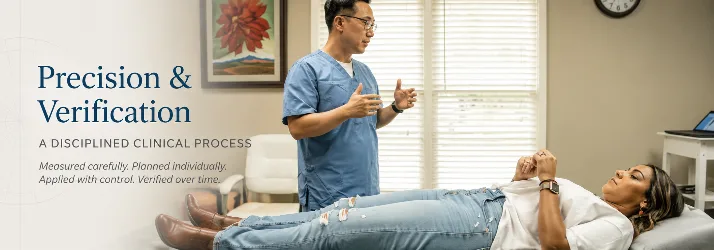
At C1 Spine Lab, precision in upper cervical chiropractic care in Duluth GA describes more than the accuracy of an instrument or the direction of an adjustment. It describes the entire clinical decision-making process—from identifying relevant findings and planning an individualized correction to controlled application and careful reassessment.
A technically precise procedure has limited value if the wrong clinical question was asked, the findings were misunderstood, or the patient's response was never meaningfully evaluated.
For that reason, our approach to Atlas Orthogonal and upper cervical care follows a deliberate standard: measure what is relevant, plan carefully, apply with control, verify the response, and evaluate patterns over time.
Our Standard for Precision Upper Cervical Care in Duluth GA
1. Define What Is Relevant
Care begins with the patient's history, concerns, examination, and current findings.
Measurements should help answer a relevant clinical question—not create an appearance of certainty. No single finding should automatically determine whether an upper cervical correction is appropriate.
2. Plan the Correction Deliberately
When the findings support an upper cervical correction, the direction and setup should reflect the individual analysis rather than a routine maneuver applied the same way to every patient.
The goal is to use available information to make the correction as deliberate and patient-specific as reasonably possible.
3. Apply With Control
When appropriate, an Atlas Orthogonal instrument delivers a focused impulse to the upper cervical region without forceful manual twisting or rotation of the neck.
Precision here means controlling the application—not assuming that greater force produces a better result.
4. Verify the Response
Reassessment is part of the process.
A correction is not automatically considered successful simply because it was delivered or because one measurement changed immediately afterward. Relevant findings should be reviewed in context alongside the patient's presentation and response.
5. Evaluate Stability Over Time
A pattern across visits may provide more useful information than a single before-and-after comparison.
When clinically relevant, symptoms, function, examination findings, and other appropriate measures can be considered together to evaluate how the patient is responding and whether the current approach remains appropriate.
Why Verification Matters After an Upper Cervical Adjustment
Verification helps answer an important question: What happened after the correction?
The purpose is not to prove that every change resulted from the adjustment. Instead, reassessment provides additional information that can help guide the next clinical decision.
Depending on the patient and the findings being monitored, that may mean continuing to observe, modifying the care plan, deciding that another correction is not currently indicated, or recommending another form of evaluation.
This distinction matters because measurement and verification should inform clinical judgment—not replace it.
Data-Informed, Never Reduced to One Number
C1 Spine Lab values structured follow-up and observation over time. Data can provide useful context, but no isolated measurement tells the entire clinical story.
An individual image, symptom score, heart rate variability (HRV) measurement, device reading, or immediate before-and-after response is not treated as stand-alone proof of neurological recovery or treatment success.
Instead, relevant information is considered alongside the patient's history, symptoms, function, examination findings, response over time, and overall clinical presentation.
Technology and measurement can support better questions and more disciplined follow-up. They do not replace listening to the patient, clinical examination, informed consent, professional judgment, or referral when another evaluation is appropriate.
Precision Without Overstatement
Precision does not mean certainty.
It means being deliberate about what is measured, why it matters, how a correction is planned and applied, and what is evaluated afterward.
At C1 Spine Lab, the purpose of verification is not to manufacture proof that a procedure worked. It is to gather relevant information, assess the patient's response responsibly, and use that information to help determine the appropriate next step.
Request A Second Opinion
TODAY
Monday
9:30am - 1:00pm
2:00pm - 6:30pm
Tuesday
Closed
Wednesday
9:30am - 1:00pm
2:00pm - 6:30pm
Thursday
Closed
Friday
9:30am - 1:00pm
2:00pm - 6:30pm
Saturday
By Appointment

C1 Spine Lab
2810 Peachtree Industrial Boulevard Suite E
Duluth, GA 30097
(770) 545-8150