

Upper Cervical Stability Over Time in Duluth GA
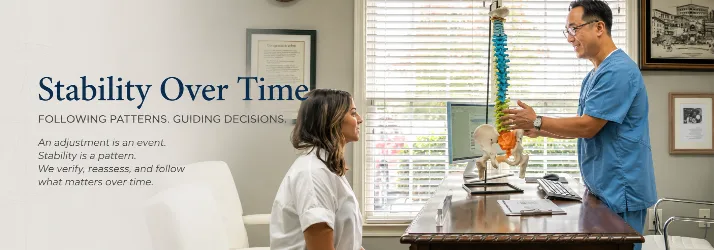
An upper cervical adjustment happens at a specific point in time in Duluth GA. Understanding the patient's response requires looking beyond that single moment.
At C1 Spine Lab, we evaluate relevant findings, symptoms, function, and patient response over time. An immediate change may provide useful information, but it does not by itself establish a lasting result.
A more meaningful pattern emerges through reassessment: Do relevant findings remain consistent? Is the patient functioning differently? Are symptoms changing? Is another upper cervical correction indicated—or is continued observation more appropriate?
What Does Upper Cervical Stability Mean?
In our approach to upper cervical chiropractic care, stability does not mean that the spine must remain in one exact position or that an adjustment is permanently “holding.”
Instead, stability describes a pattern observed over time in which relevant clinical findings and the patient's overall response become sufficiently consistent to help guide the next decision.
The upper cervical region contains joints, muscles, and sensory receptors that contribute information used by the nervous system for head position, movement, posture, and balance. These relationships are part of the clinical context we consider, but they should not be used to make conclusions that the available findings cannot support.
Our goal is therefore not to claim that an upper cervical adjustment “stabilizes the nervous system.” It is to evaluate the patient over time and determine whether continued correction, observation, modification of care, or another form of evaluation is appropriate.
Why Reassess After an Upper Cervical Adjustment?
Reassessment helps determine what happened after care and whether another correction should be considered.
At C1 Spine Lab, an adjustment is not automatically repeated simply because a patient returns for another appointment. Relevant findings are reviewed in the context of the patient's symptoms, function, clinical presentation, and response since the previous visit.
Depending on those findings, the next step may be to:
- Continue observing without another correction
- Perform another upper cervical correction when clinically indicated
- Modify the care plan
- Evaluate other factors that may be relevant
- Recommend referral or co-management when another type of care is appropriate
The purpose of reassessment is not to prove that an adjustment worked. It is to gather useful information for the next clinical decision.
Recovery Does Not Always Follow a Straight Line in Duluth GA
Patient response can vary.
Some people may notice changes early in care. Others may change gradually, fluctuate, plateau, or experience little meaningful change.
A short-term improvement does not prove that the result will persist. Likewise, a plateau should not automatically be interpreted as evidence that an unseen healing or neurological process is occurring.
Instead, changes should be considered in context and compared with the clinical plan. When the pattern does not support the expected direction of care, reassessment becomes especially important.
Stability Before Repetition
Does Every Upper Cervical Visit Require an Adjustment?
No. An upper cervical adjustment should not be performed automatically simply because a visit is scheduled.
When relevant findings remain stable, repeating a correction may not be indicated. When findings change, the decision about whether to adjust should reflect the current evaluation and the patient's overall response.
This principle is central to C1 Spine Lab's approach: the decision to correct should follow the findings rather than the calendar.
The objective is not to deliver the greatest possible number of adjustments. It is to determine whether an upper cervical correction is appropriate at that particular point in the patient's care.
How Do We Evaluate Progress Over Time?
No single measurement tells the entire story.
When clinically relevant, progress may be evaluated using a combination of:
- Patient-reported symptoms and changes
- Functional response
- Examination findings
- Relevant clinical measurements
- Response to previous care
- Patterns observed across multiple visits
These findings should be interpreted together rather than treating one image, device reading, symptom score, or immediate before-and-after change as stand-alone proof of treatment success.
Data informs the decision. It does not make the decision by itself.
The Standard in One Sentence
Measure carefully. Correct gently. Verify honestly. Follow stability over time.
That standard connects measurement with clinical judgment, Atlas Orthogonal upper cervical care with reassessment, and immediate response with longer-term observation.
Individual responses vary. No particular outcome, number of visits, duration of care, or timeline for improvement can be guaranteed.
Request A Second Opinion
TODAY
Monday
9:30am - 1:00pm
2:00pm - 6:30pm
Tuesday
Closed
Wednesday
9:30am - 1:00pm
2:00pm - 6:30pm
Thursday
Closed
Friday
9:30am - 1:00pm
2:00pm - 6:30pm
Saturday
By Appointment

C1 Spine Lab
2810 Peachtree Industrial Boulevard Suite E
Duluth, GA 30097
(770) 545-8150